The "Light Alloy and Rare Element Separation" research group at the Qinghai Institute of Salt Lakes (ISL), Chinese Academy of Sciences, has achieved significant progress in the field of environmental photocatalysis. In a collaborative study published in Nature Communications, researchers have developed a novel strategy for the one-step in-situ construction of anionic and cationic dual defects. By leveraging defect engineering to create defect dipoles, the team successfully induced nanoscale-enhanced built-in electric fields, thereby driving efficient carrier transport and separation. This breakthrough provides a robust solution for the high-efficiency photocatalytic degradation of recalcitrant organic flotation agents in salt lake environments.
Background: The Environmental Challenge in Salt Lake Development
Octadecylamine (ODA) and 4-dodecylmorpholine (DMP) are critical flotation reagents used in the production of potash fertilizer. However, characterized by low water solubility and high structural stability, these compounds are resistant to natural degradation. The long-term accumulation and enrichment of ODA and DMP in salt lake regions not only pose a potential threat to the ecological integrity of these unique environments but also constrain the development of potash and other high-quality salt lake chemical products. Consequently, the development of high-efficiency degradation technologies for potassium flotation reagents has become an urgent priority for the green and high-value utilization of salt lake resources.
Innovative Strategy and Methodology
To address this challenge, Professor Ye Xiushen and Associate Professor Zhang Siyuan from ISL-CAS, in collaboration with Professor Hou Jungang (Dalian University of Technology) and Professor Shi Weidong (Jiangsu University of Science and Technology), proposed a novel approach based on the physical concept of dipoles combined with materials science defect engineering.
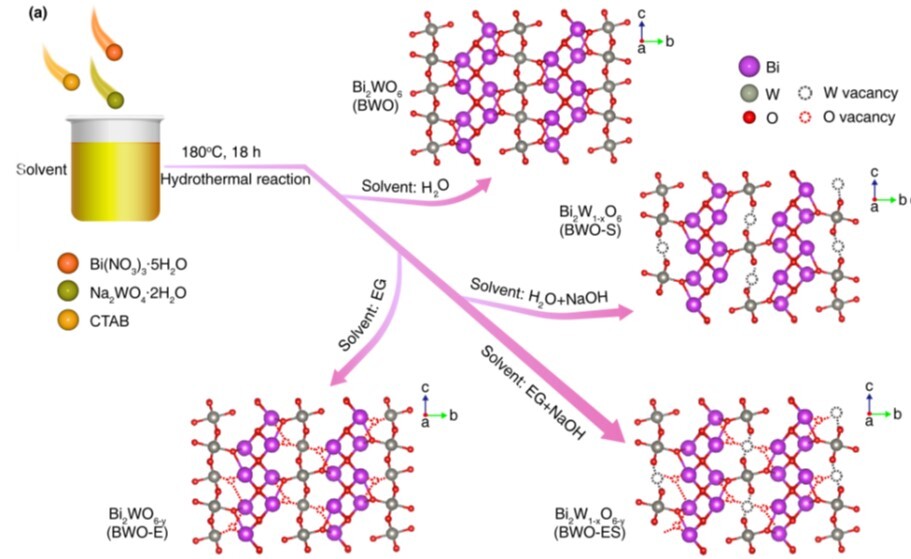
Capitalizing on the unique environmental conditions of the high-altitude region—specifically the high intensity of natural solar irradiation—the team focused on defect-engineered photocatalysts for the enhanced degradation of ODA and DMP. They developed a "one-step in-situ" synthesis strategy involving the addition of specific proportions of ethylene glycol (EG) as a reductant and sodium hydroxide (NaOH) as an etchant during the hydrothermal preparation of bismuth tungstate (Bi₂WO₆).
This process successfully constructed dual defects comprising anions (Oxygen, O) and cations (Tungsten, W) within the material. Crucially, the synthesis achieved a region-specific distribution of these defects:
• Oxygen defects were concentrated in the central region of the Bi₂WO₆ nanosheets.
• Tungsten defects were distributed along the edge regions.
Figure. 1 The schematic synthesis processes of BWO, BWO-S, BWO-E and BWO-ES.
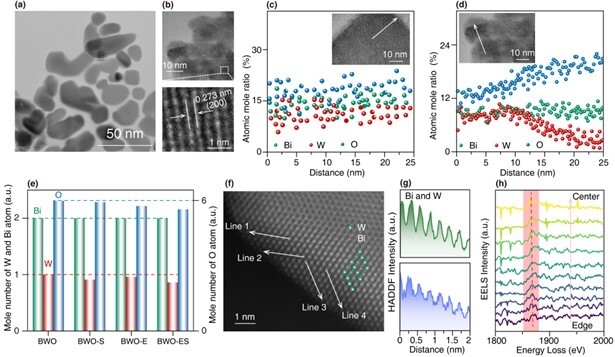
Figure. 2 W and O vacancies spatial distribution
Mechanism of Enhanced Photocatalytic Activity
The study provides an in-depth mechanistic analysis of how these dual defects induce the formation of defect dipoles to enhance photocatalytic activity:
1. Defect Dipoles and Built-in Electric Fields: The spatially separated O-defects and W-defects function as positive and negative charge centers, respectively. Within the nanoscale space, these defects form defect dipoles. This structural modification dramatically increased the electric dipole moment from 1.54 D in the bulk material to 48.15 D in the dual-defect material (BWO-ES). Consequently, the intensity of the induced built-in electric field was enhanced by 2.74 times.
2.Carrier Dynamics: This amplified internal electric field provides a powerful driving force for the efficient transport and separation of photogenerated electron-hole pairs, significantly suppressing carrier recombination. The transient fluorescence lifetime was extended from 1.61 ns (bulk BWO) to 2.63 ns (BWO-ES).
3. Band Structure and Active Sites: The construction of defects narrowed the material's bandgap (2.78 eV → 2.54 eV), enriched surface active sites, and increased oxygen adsorption energy, thereby substantially boosting the generation of reactive oxygen species (ROS).
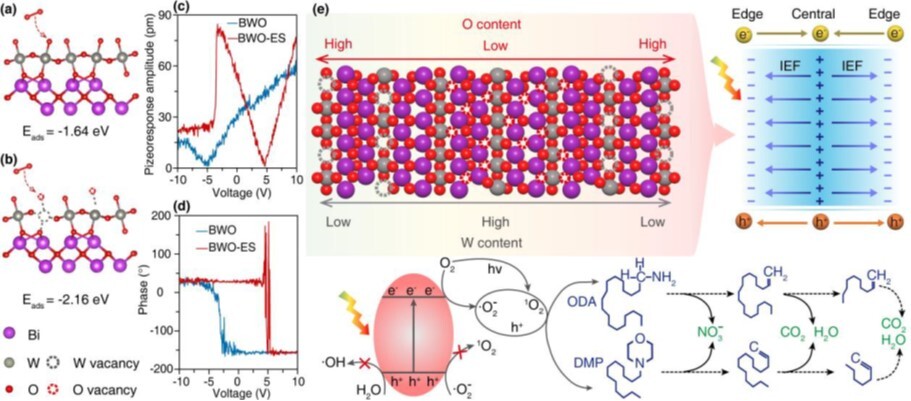
Figure. 3 Defect dipole formation and degradation mechanism
Performance and Practical Application
Under visible light irradiation (λ ≥ 400 nm), the BWO-ES photocatalyst demonstrated superior degradation performance:
•Degradation Rates: The degradation rates for ODA and DMP reached 13.31 mg/L·h and 14.40 mg/L·h, respectively.
•Efficiency: These rates represent a 3.64-fold and 3.59-fold increase compared to the bulk BWO material.
Furthermore, the team validated the catalyst's practical utility by applying the BWO-ES photocatalyst to the treatment of actual potash flotation tailings. Under conditions of natural sunlight, the material achieved the complete degradation and mineralization of ODA and DMP within a single day, demonstrating excellent stability and potential for industrial application.
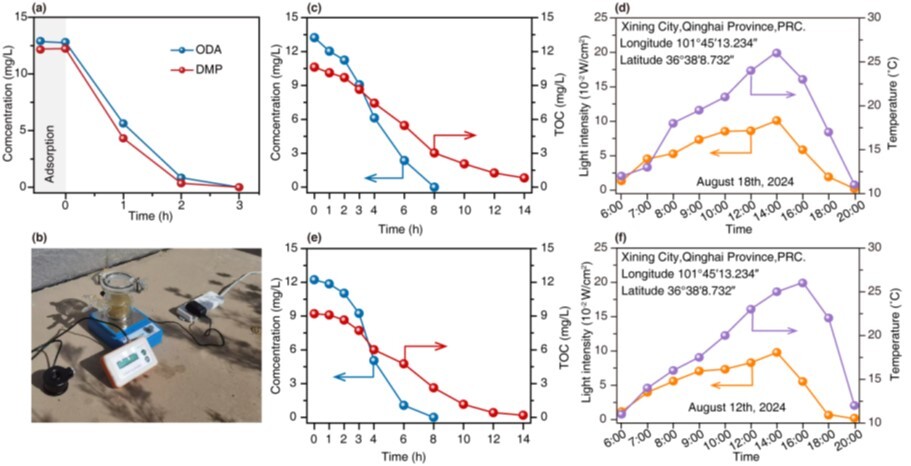
Figure. 4 The degradation capability for the real-world flotation tailing wastewater
Article links:https://doi.org/10.1038/s41467-025-66466-5
Reference format:Ma, L., Zhang, S., Liu, H. et al. Region-specific defect engineering of Bi2W1-xO6-γ induces nanoscale electric fields and surface active-sites for enhanced visible-light oxidation of salt-lake flotation agents. Nat Commun (2025)


 Introduction